Wednesday, September 08, 2021

You Broke Your Ankle On That Last Heel-Turn

Of all the things I'd expected to see in 2021, "the staff of the former Weekly Standard becoming apologists for abortion" was not one. I've said for years that being in professional punditry usually means that you're for sale (or at least constantly open to being malleable) to some extent, but what Jon Last & Co. have done the last couple of weeks has been off the charts.

I blocked these folks on Twitter, but I apparently have impulse-control problems, because I really want to get this out there.

Amanda Carpenter, who briefly wrote at RedState, Townhall, and other places while making buck on being conservative, and eventually joined Ted Cruz's team long enough to help him accuse Middle Eastern Christians fleeing ISIS of anti-Semitism (with press coverage of the whole thing!), has New and Important Thoughts:


Never heard that one before, by which I mean those exact words in exactly that order; the thought, such as it is, is a hoary 1970s cliché that didn't even meaningfully track the pro-life movement then, let alone now. (Ask the Catholic Church about mandatory support for pregnant women and new mothers. Ask most Evangelicals. Ask the women and men praying outside of abortion clinics. Heck, ask anyone but your reply-guys on Twitter.) But she's just putting it out there, offering thoughts that doubtless seem as clever as this one:


(BEE-TEE-DUBS: Based on CDC's reporting (here), the effective mortality rate -- the danger, if one will -- of the prevalent Delta strain is less than half of Original Recipe COVID (.7% against the old 1.7%), measured by deaths and hospitalizations; and the danger for children is even less relative to Original Recipe, with a mortality rate, based on that same, publicly-available and easily-found CDC data, of a whopping 0%, especially when controlling for pre-existing conditions like cancer. But let's not let facts stop us here.)

Anyway, Carpenter's transition from Diligent Water Carrier for Biggest Publicity Hound in the Senate to Righteous Karen Terrified of a Virus Moving in the Usual Way on the Transmissibility/Virulence Axis is surprising, and indeed, moreso than the living senior moment at the Bulwark:


Bill Kristol has been increasingly out on an ice floe for a while, and it ill-behooves us to mock those going senile in the public eye, so I'll simply note that (1) the objection appears to be that nominally pro-life politicians will be required to actually establish some sort of bona fides; and (2) "passing a law that stops abortions from happening is awful for the pro-life movement" is one of those takes so hot that Slate would be yelling, "Yeah, no, thanks, we'll pass."

(I have no idea what Jim Swift thinks because it's remarkably unlikely to be worth unblocking.)

At the core of this is the one in this bunch who doesn't have the ready-made excuse of being dim or daft.


Oh, he doesn't mean all pro-lifers, just pro-lifers who support a bill that explicitly eschews penalties on women seeking abortions and instead tries to destroy the whole supporting apparatus. Just those clod-eaters. The sincere ones (who just keep quietly hoping and praying everything will get better, keep those opinions to themselves, and didn't have the unmitigated gall to vote differently than the man who spent years talking about the danger of the pro-life movement being monopartisan), why, they're fine.

If you'd told 2017 Me that Jonathan Last, of all people, would transform from cynical-but-sincere pro-lifer to mindless reciter of left-wing garbage, 2017 Me would have laughed in your face. 2021 Me has learned some hard lessons about sincerity the last several years -- not about politicians, who'd step over their own mothers for a permanent one-point bounce in the polls -- but about people who get paid to give their opinions. But now?


Worth remembering that once he was free of the ... shackles of conformity ... imposed by being a staffer at one of the more iconoclastic right-of-center publications, he opined that the Alabama abortion law -- designed explicitly as a shot across the Supreme Court's bow -- was terrible politics, too (as were the South Dakota law, the Georgia law, etc.).

The stated point of a pro-life movement is to get protections for life from conception to death enshrined in law. A pro-life movement that explicitly chooses to be toothless, that eschews law and challenges to miserable and a-constitutional decisions like Roe and Casey, that favors Democrats' status quo over a change that might save lives, that would rather simply rail in the darkness with no one listening -- well, it probably deserves a place on The Bulwark's masthead.

Friday, July 12, 2019

But For Constant Intervention Abroad, Richard?

Can political parties have souls in the way political romantics like to think?

"We're fighting for the soul of the [Republican/Democratic/Libertarian/Very Silly] Party" is the sort of thing a certain group of people -- namely, people who don't know what souls are and who think politics is anything other than war by other means -- tend to say. It rallies their fellow believers, it inspires people who couldn't even cut it as English majors and so became communications/journalism/philosophy majors instead, and by golly, it makes one feel important as one sets about mustering votes to control the selection of the humans who will at most perform a fraction of the tasks they promised getting there.

But it's nonsense on stilts, because parties don't have souls; humans have souls, immortal ones, and Neo-Platonic nonsense notwithstanding, humans don't contribute to any kind of oversoul, nor do their partisan allegiances somehow forge their souls together like Superion forming from the Aerialbots.

Not pictured: The soul of any political party.
This does not mean that the phrase is ineffective, even if it's stupid; a great many stupid things are very effective. As I say, it's a very good way to rally the ideological troops and to try to convince leaners that one is in the right in a fight over who gets what committee chairs and whether some future mildew-gathering upright ape will have to retire to a different profitable sinecure.

But it's still stupid, precisely because parties don't have souls; they don't even, in our system, have fixed ideological positions or tendencies. They necessarily move and shift as the humans who compose them do; and as they add or subtract humans, those things change in different ways, as well.

So if one says I'm fighting for the soul of the Republican party, it might not be a bad idea to be sure one knows what that means in practice.

I'm going to drop, very briefly, my smug jackass routine to put some cards on the table. I totally called it wrong in 2016. I was pretty sure JEB! (who was a great governor, and I mean that) was gonna run the table for the GOP nod; and when he faltered, I was sure everyone else would start dropping to keep Trump out of the nominee spot; and when that didn't happen, I assumed primary voters would wise up and get ahead of the Dorito Lord; and when that didn't happen, I was pretty damned sure Hillary would win -- not by a lot, but by enough, popularly and electorally, to be dispositive.

I made all of these mistakes because I totally misjudged the "soul of the Republican party" (and because I read stories about problems pollsters were having identifying where voters were and assumed that this represented statistical noise that campaign machines would cancel). I completely missed it. I thought partisan and ideological realignment were so complete that outside of a populist rump that swung between the parties, and that rump was enough for 1-2 percent of the vote in a handful of states, at most -- and that the margins weren't close enough for that to matter.

I was so, so wrong.

Part of adulthood is identifying one's mistakes and learning from them. So the lessons here, or two of them, are that insofar as the "soul of the Republican party" means anything, it's only a situational thing, variable over time and even instantaneously, which really means "nothing"; and insofar as that "soul" was post-World War II fusionist-conservative, that isn't and hasn't been the case in a while. I made this mistake because Republican presidential candidate after Republican presidential candidate had to at least pretend some level of conservatism in the primaries and the general election; because I was so immersed in conservative commentary that I forgot my own rules about identifying selection bias; and because of my own experience, in which the populist members of my exceedingly large family have by and large remained Democrats over time, meaning their votes were already accounted-for.

These were mistakes, the last particularly stupid, and I've corrected them.

The Republican party, as currently constituted, is -- ideologically -- a fusion of true-blue conservatives, libertines-masquerading-as-libertarians-who-care-slightly-more-about-economics-than-sodomy, social conservatives who don't care about the rest, legacy Republicans, populists, foreign policy hawks, foreign policy isolationists, some racists who prefer the kind they think they sniff in dedicated arguments for vouchers more than the Democrat anti-Semitism variety, and single-issue voters of various stripes. Conservatives are not a majority. Populists, who tend to have at least some overlap with every one of those groups except the libertines and a handful of single-issue voters, are essentially in the catbird seat.

You may (quite fairly) blame Nixon, Reagan, and Gingrich for this state of affairs; you may blame Trump. You're blaming the people who won, which suggests the exact connotation of the word "blame" here. Each of these men intuited -- for different reasons at different times -- that there was and is a strong populist element in our country, and harnessing it is the key to electoral victory.

Populism is a corrosive force, destructive of institutions and republican governance (though whether that matters appreciably in a system with low institutional trust and devastated small-r republican governance is another matter altogether). It even eats away at civil society. It inevitably gives rise to clannishness and worse, anti-Semitism and other species of racism being prime examples. It is one of the things our system was designed to combat.

But it is very real, and it's been a very vital force in our system since the Democrats realized they could encourage and harness it two centuries ago. It is abetted by universal suffrage and by a thousand less noble things, none of which are going back in the bottle any time soon. And it's a driving force in both parties, where as recently as 2000, we thought it only Al Gore's latest firmware update. You can try to tame or redirect it, you can grab it by the tail and hold on for dear life, or you can get swallowed by it. Ignoring it is exactly as stupid as thinking that you can tell a great deal about millions of Americans based on the people you personally know.

It is this complete misunderstanding that drives so much commentary in the, sigh, Never Trump universe. (I refuse to use a hashtag because screw you, I'm older than 16.) I was one of that group (no hashtag, even then older than 16), and the point was very clear: Stop the orange clown from getting the GOP nod and making the conservative and Republican labels even stinkier to impressionable children, ages 16-35. We failed. Anyone who cheered on the 2012 postmortem should have been enthusiastic about doing a 2016 one on conservative efforts to take down Trump, and the response has largely been ... being angry that Donald J. Trump is a conniving, lying, scheming, adultering, cheating, malicious, petty, vaguely racist, misogynistic boor who somehow grasped the brass ring despite himself, and carrying on as if nothing happened.

2016 happened. The ground shifted under us and we didn't notice until very late in the game. Pretending that excising the Trump Cancer will somehow both restore the GOP to c. 2003 A.D. forms and ideology, and also win elections, is madness, and yet here we are. You like Paul Ryan? Heck, I like Paul Ryan a lot. I like Marco Rubio, too. You know who doesn't? GOP voters and swing voters. You know who wins this debate? Let me give you a hint: Ryan is retired and Rubio is going to be a Senator, at most, for four more years; President Dorito Lord is currently reminding the Never Trump holdouts that a primary against him is a waste of time and money. And Bill Weld won't save you.

(Contemplate the absurdity of anyone imagining he would, even if he could.)

Populism's ascendance to parity or better with fusionist conservatism in the GOP is a problem if you believe in and want the old coalition back. Instead of dealing with this problem head-on, far too many of those wounded by it spend too much time in echo chambers on social media, participants or observers, reassured in their righteousness and shrinking farther from relevance not only today, but from the people who will be there post-Trump and are not going to put aside human nature to say, Your program that got clobbered by Obama twice and Trump once or twice sounds like a winner to us, sign us up. They're locked in the floor fight of the 1976 Republican National Convention, certain that Goldwater's pitchman is about to vindicate the doddering libertine.

Of course, that was 43 years ago. Someone, please let them know.

Identifying the problem does not mean surrendering in its face. Trump shamelessly employed populism to win and has precious little intention of using it as more than a prolonged marketing campaign. Nixon, Reagan, and Gingrich harnessed it to leverage their way to increasingly-conservative governing majorities and outcomes. Fox News uses it for ratings and very little else. Populism by definition isn't an intellectual exercise, it's a roar of righteous outrage, and emotions are much easier to channel than cold thoughts, for good and for ill. You might even say this isn't a new insight.

Pretending it away, however, won't merely fail to work, it will blow up in your face, and likely take your awesome magazine with it.

Stop. Be the grown-ups you've been before. Join us in the here and now; learn from the mistakes that made Trump's rise possible and your own, and Trump's and his thronesniffers'. We have a party to take back, even if it's different than the one we were sure we had.

This won't work if the past and the present are the undiscovered country.
___
Image of Superion is: Superion, by Atsuhiko Sugita of Studio OX. Scanned from Transformers Visualworks. Copyright TakaraTomy and Studio OX 1986, via tfwiki.net. Low-res image used for non-commercial educational/commentary purposes only. No advertising revenue is taken on this blog. Heck, virtually no one reads it. For takedown requests, please leave a comment below with contact information.

Thursday, June 20, 2019

They All Fall Down, Part Some Large Exponent of Ten


If you gaze too long into The Donald, The Donald gazes back into you.

And everyone is dumber for it.

The problem of Donald Trump hit the conservative movement like a problem-shaped figurative landmine hitting a foot, which is to say reactively, with explosive force, and with a great deal of collateral damage. (That metaphor sounded much cooler and smoother when I started than when I finished, but blogging is great for indulging rhetorical flights of fancy.) The vaguely brutal reinforcement of the fact that conservatives are at best a plurality in their own party hit the movement hard, fracturing old alliances; altering priorities; and realigning the entire thing around an orange, blustering lodestar, in opposition, alliance, avoidance, or some combination.

I'd thought the fallout more or less reduced to rival camps of people with way too much time on their hands putting cured meat products on the table of Twitter when the Weekly Standard up-and-died.

I'm hesitant to say too much about the Standard for fear I'll reduce this to a blubbering series of nostalgia-painted trips down my incredibly hum-drum memory lane, but I'll say that from when I was in law school through late last year, the one conservative publication I consistently read was the Weekly Standard. Cheeky, insightful, funny, smart, never self-reverent, witty, and never afraid to be introspective, it was everything a 22-40 year-old guy who thinks too much of himself wants to imagine he'd write.

Three of my favorite writers -- Andrew Ferguson, Matt Labash, and Jonathan Last -- could be found there, and I devoured their articles the way Rosie O'Donnell devours inhabited planets. Last will always have a special place in my heart, for his cheerily-doom-ridden obsession with (declining) demographics on a par with mine; my one major point of disagreement with him was in his identification of Labash and Ferguson as top-shelf writers without including his own name. He never had their flair; he always had the boards nailed down and the carpet perfectly placed. As anyone who's ever written and edited knows, this is a non-trivial accomplishment, even for nominally accomplished writers.

And then the Weekly Standard just died. Poof. Its increasingly strident tone against the Trump Administration -- of which it had not been fond since before there was one -- was cited as one explanation. Another was the consolidation of conservative opinion mags. From my perspective, its constant ownership shifts made it look perilously like The New Republic, but without billionaires in love with eugenics and sodomy to bail it out.

When Last teased a successor, and then it launched, I was relieved. There was hope! A great publication had been saved!

Not so much.

The Bulwark is something of a case study in what happens when one is (1) convinced one is the last righteous man standing (2) obsessed with the demon that laid low or corrupted one's former allies and (3) unmoored from any need to hide either of those things. Publishing the creepy stalker-of-women-on-Twitter guy (whose primary oeuvre is screenshotting conservatives sympathetic to The Weekly Standard and also conservative women, but especially the latter, to hold them up for mockery) and giving Molly Jong-Fast a byline to discuss, inter alia, the pro-life movement as part of the conservative movement can only make sense if your priority is not preserving 1990s-2000s era conservatism so much as it is the absolute destruction of Donald Trump and anyone saying anything that could possibly so much as help someone who helps someone who might help him.

Worse than bad writer selection, however, is the content. To call The Bulwark obsessed is to engage in understatement so profound the very language might collapse on itself; a fate that, philosophically, has struck the Bulwark as well.

I'll offer an example, drawn from using the site's search engine to search for two terms: "the" and "Trump."

A search for "the," which should theoretically yield every article posted on the site, yielded 537 results. A search for "Trump," unsurprisingly, yielded pretty close to every article posted on the site: 445, or 82.87%, of the "the" results. (The Bulwark's search function appears to be default-Boolean, so articles like "The Age of Trumpshevism" did show in these results.)

Perhaps I'm being unfair; as I said, I tend to put Last on the top shelf of editorial and analytical thinkers of my generation, and his hand is, according to the masthead, the last or one of the last to open the bomb-bay doors. Let us therefore look at the stories on the first page of the "Trump" search:


(My mad Photoshop skills are neither mad nor usable when I don't have any tools other than the ones Microsoft hands out for free, so I've reproduced the links below.)
How to Impeach Donald Trump
It’s a Terrible Idea for Trump to Cozy Up to Nigel Farage
Only the Best Deals: How Trump Got Pantsed By Mexico
The Definitive Explanation of Why Donald Trump Is Bane from The Dark Knight Rises
The Trump Kids Go Royal
Sohrab Ahmari’s ‘Culture War’ Is Really Just About Donald Trump
Trump’s Poverty-Line Proposal Is Wonkier Than It Seems
Trump Wants Our Allies to Spend More on Defense. Is That a Good Idea?
Trump’s Mexico Tariffs Are Forever
America’s Trade Laws Were Not Designed for a President Like Trump

Of these, I think it's safe to say that an instruction manual on impeaching someone is disfavorable to the impeachment target. Similarly, describing someone as "pantsed," even the great Wade Boggs, is not a kindness. Making an explicit equation between someone and a completely uninteresting villain from a completely uninteresting movie from a badly overhyped superhero movie sub-franchise does not rate high on the compliment scale.

Any piece by the odious Jong-Fast is, by definition, going to be harsh to Donald Trump and the conservative movement of which the Bulwark claims to be one of the last standing parts. The Bulwark's decision to briefly be the Paper of Sohrab Ahmari Record was apparently incomplete until it topped off with an explanation of how the intra-right contratemps Mr. Ahmari set off, and against whom the Bulwark set itself, was really all about Trump.

That leaves five pieces that, from the headline alone, cannot be sussed out. (In the interest of full disclosure, I read each of the pieces here, because few things are as obnoxious as headline-sniffing, with the possible exception of headline-baiting, which we're all supposed to pretend is basically fine because clicks.) Let's look at those.

The Nigel Farage piece is really an explanation that Nigel Farage sucks, and Donald Trump does as well, for treating him seriously. (The Tories are currently treating Mr. Farage quite seriously for the same reasons Mr. Trump does, which is quite beside anything mentioned in the piece; the analysis of how playing nice with Farage undercuts the Tories (and Labour? the 9/11 discussion makes this mixed) would be much more compelling if the Conservatives weren't doing a fine job of undercutting themselves.)

The poverty-line analysis piece is a relatively even-handed look at a policy proposal that conservatives have favored for years, with a conclusion that ... it likely won't matter all that much, and either should or shouldn't be enacted, who knows.

The NATO defense target piece carefully notes that (1) it has been a policy of multiple Administrations to urge or require Europe, and especially NATO, to spend more on defense; (2) they have not (but they're starting to! sort of!); (3) if they do hit their defense spending targets, it will likely be on soldier welfare (as opposed to the civilian welfare systems most of their armed services already use, one supposes); (4) even if they spend money, it would "only" be worth a few aircraft carriers, ships we all know aren't terribly useful for combat; and (5) if we do, we're begging for European regional hegemons and possibly another Reich or World War. (The implicit answer to the headline, then, is "no.") Unmentioned is that conservatives have been pushing for greater NATO defense spending by constituent powers for decades, an omission that makes perfect sense because reasons. There is a complicated dispute bound up in this question, involving America's sway over NATO, member-states' publics' support of military spending and American military measures, American support for military actions abroad, the decline of Russia from world power to regional hegemon-basket-case, military focus on the Far East, and a dozen other concerns, of which "maybe Germany will re-arm and grab Eastern France and Poland" isn't even remotely one.

Days before Mexico made (possible) concessions and the tariffs at issue in the penultimate piece were called off (for now), the Bulwark announced they'd never be called off because, and I do not believe I'm being unfair here, Donald Trump is an idiot who painted himself into a corner on tariffs and is too stupid to realize it and will never end them. That he did is best explained as ... being too stupid to realize that he'd been pantsed by ending the things we were all confidently told he wouldn't end.

Finally, there's an analysis by the ever-demure Andrew Egger explaining that a late-1990s Congress was too stupid to realize that handing off unilateral authority to the President can be dangerous. While repeatedly emphasizing the stupid, blundering nature of the current occupant of 1600, the piece does close by noting that this is an instance in which Congress was too generous with its powers, and that maybe reconsideration, post-Trump (or intra-Trump!) is needed.

Thus, there are eight highly-unfavorable-to-merely-unfavorable results in that latest ten hits (as of June 18, 2019) for Donald Trump, one of which hammers Donald Trump for pushing a policy endorsed by numerous Presidents and years of American conservatives. There are two analysis pieces, one of which skips right past the fact that the Trump administration is enacting a conservative policy choice in order to suggest it may be a bad idea (or not!) and another to say Donald Trump is so singlehandedly bad, Congress has to have learned a lesson or two by now. Reading deeper does not change this: From only the coverage on The Bulwark, one might reasonably infer that Donald Trump's administration has quite literally done nothing right, from a conservative or even competence perspective.

This is demonstrably silly. One does not have to think the Trump Administration, or its head, has always been right to note that a lot of things have gone well precisely because a lot of traditional conservatives and Republicans swallowed their bile and stayed the course. Judges, Middle East policy (sorry, Rand Paul), life issues(!), heck, even arguably immigration, depending on which part of the screaming parts of the conservative movement one surveys on that front on any given day -- all have had at least reasonably good outcomes.

Let us get something out of the way, many, many paragraphs later than the Bulwark would like or would believe appropriate: Donald Trump is a clown, a crass man who in any reasonable time would not be President unless he first served in the Senate and happened to be Vice President when the squalid, raping, aborting, philandering, vicious, nasty, casually-racist President under whom he served was assassinated. (Thus, a Democrat, in party registration as well as fact; but a proto-neocon, so perhaps occupying a warm spot in the Bulwark crowd's heart.) His presidency has had its share of errors-to-disasters and then some, most notably, on immigration (again, depending on one's perspective; in this case, I think it the one grounded in reality), tariffs (not since George H.W. Bush has any Republican tried so hard to raise tariffs on Americans while pretending it away), and let's just say "communications" has been a byword for "hash." Additionally, there is no need to play carrot-and-stick; The Bulwark acts as essentially Breitbart's mirror image, the back of the hand to the soft, loving palm, and this is a perfectly reasonable position to take.

Someone has to be the guy telling the town drunk to go home, he's making an ass of himself, even when the bartender is slipping him another whiskey. That's an honorable role to fill, although it's a bit much when you follow the guy home, yelling at him the whole way and rousing the whole town in the process.

The essential problem is not even that the Bulwark is obsessed with Trump. He's the President, and that staff has loved an imperial presidency right up until someone they hate with the hate of Rosie O'Donnell facing a diet plan sat in the Oval Office. They're within their rights to focus on the man they basically see as an illegitimate usurper of the throne.

The problem is that they've lost all touch with perspective. It's not just the ridiculous byline pieces -- authors chosen for their open, seething hatred of Trump over the wit, pinache, and learning that used to occupy the Weekly Standard. It's not just the sudden policy shifts -- the Alabama abortion law is not merely a tactical error, but is actually a world-historical betrayal of a movement dedicated to ... ending legalized abortion. It's not the skewed policy perspective -- quite aside from now wanting NATO to bear less of NATO's burden, it appears that making a government-mandated exemption from civil liability dependent on actually complying with the original conditions for that exemption is a form of statism. It's not just treating Bill Weld(!) as a serious candidate for the presidency, something even his exhumed mother would not be able to bring herself to do.

It's all these and more. Altogether, it suggests an unmooring from decades of principles for the sole purpose of screaming at and about Donald Trump, and destroying anything aiding him, even to good outcomes. It is a derangement. It is stupid, precisely because it is unthinking, or worse, surface-level thought in defense of a lack of it.

It is neither too late nor too hard to end this experiment in madness; the writers are smart enough, Egger being the possible exception, and decent enough, the stalker guy and Jong-Fast being the obvious exceptions to that, to at the very least remain solid on principles while opposing the man they hate. The alternative is to be a revanchist holdout of a world that never existed outside of their own imagination, so determined to slay the blundering ogre that they force their own allies away in the process; or, worse, a laughingstock.

The conservative movement has fractured; that doesn't mean that some of its leading lights must lose their mind. I would submit that they should not, for their sake and ours.

Nevertheless, my bet is that they remain what they've become: The Mirror Universe Breitbart (or worse, to their mind: Federalist). My further bet is that they scoff at this even as the world drifts away from them, reassuring themselves that at least they don't champion hopeless or despicable causes.

And yet: Bill Weld.

Wednesday, June 05, 2019

Probably could have left it at this, to be honest.

Tuesday, June 04, 2019

I need to do this more often.

I forget how much fun I have writing something that doesn't need jump cites until I do it, and then I get addicted again.

The Beatings Will Continue Until the Stupidity Ends

The most attractive part of the human body, based on centuries of human experience, is not the face, or the legs, or the midsection, or the chest, or the hips, or any genital; but, rather, the navel. This has come into starker relief now that we as a society have discovered that our ability to share our most trivial insights with a waiting world is quite literally at our fingertips. It is made worse in the face of absolute futility of action, something to which American conservatives would be absolutely conditioned but for the historical success of a former Democrat who launched one of those epochal political revolutions that happen in our system from time to time.

I have very little to add to the Sohrab Ahmari-David French affair that has consumed the attention of people who write about ideas, politics, and political grunting for a living, because this entire contretemps is not even a disagreement over tactics, or strategy, or even temperament or attitude. It's a disagreement that cannot even agree on the field of battle. 


On the one hand, the one side correctly notes that we have entered the stage of the culture wars in which evil may safely shed its love of tolerance because it has the upper hand. On the other hand, the other side correctly says that political liberalism has delivered on the promise of peaceful coexistence and prosperity. Many pixels have died to make exactly these points, changing no one's mind in the process.


Each may find fault, I would suggest with great accuracy, with the other. But they're not even talking to each other. They're simply staking out stances, because neither really grasps the import of why they're yelling past each other; or, worse, simply doesn't have a solution except to keep doing what it has done so far. 


The real problem here is simple to identify, but hard to solve. It is actually a combination of both positions: We are part of a liberal political order. (Here, I mean the word "liberal" in its classical sense, which refers to sometimes-muted popular sovereignty over and against the authority of a monarch, buttressed by norms and rules and laws both substantive and procedural; so the American system, for example, is liberal, while the Saudi system, by contrast, is conservative. This does not map perfectly onto how we perceive conservatism, which is a spectrum of rightist attitudes including some species of political liberalism, or progressivism, which historically includes others.)

Within the liberal order is the underlying presumption that whichever side wins a debate, absent a structural violation, wins. The other side must briefly yield, even if promising to reverse the effect through liberal means -- debate, persuasion, and votes taking in representative bodies. But as ours has recently evolved, it is one in which one combatant is slowly but surely and successfully using illiberal tactics and strategies not merely to deny the other victory, nor even to deny it legitimacy, but to deny it access to the tools of liberalism and therefore the system; and the real battlefield, for now at least, is the governed, who cannot fathom a world outside that liberal order but who are constantly bombarded with cultural messages about the rightness of the side abandoning liberalism. 

Indulge me in an example near and dear to my heart. Assume Republicans retake the House and expand their majority in the Senate. They also grow spines. They send up a budget not merely stripped of Planned Parenthood funding, but that instructs that no Medicaid funds may go to any abortion provider. States may use their own funds as they will, but Federal funding is right out. Trump, because he's not smart but he knows marketing, signs this. 

Raise your hand if you honestly believe a venue-shopped District Judge won't void that part of the budget because reasons. Keep it up if you think the Ninth or Fourth or Second Circuits, where venue will probably be, won't affirm. If the Trump years have taught us anything -- an open question -- it is that the total absence of a Constitutional basis for this behavior is irrelevant.

Now strain your shoulder to the tearing point if you believe (1) SCOTUS will take cert and (2) there won't be a non-stop media, every medium, war on the GOP for denying funds to people who provide mammograms even though their leadership has testified under oath that they do not, in fact, provide mammograms. 

As the great Justice Antonin Scalia noted, the Court is designed to be illiberal but limited, and is instead illiberal and expansive, and we have tacitly accepted this; and where the Court has not ruled or has ruled in our favor, we face a multi-pronged assault from tiny but disproportional elements of what's left of civil society that serves to deny us legitimacy even in the eyes of our own representatives. If you doubt that, look at subdued reaction by every, single major Republican candidate in 2016 to Obergefell -- or more precisely, to the demands by their constituents that they rein in the Supreme Court's ad hoc lawmaking. One hundred and fifty years ago, a future President railed against unjust Supreme Court adventurism. Today, we shrug and accept the destruction of our system by men and women sworn to uphold it because their social milieu demands it. As the late Justice Scalia also noted, "when the Court takes sides in the culture wars, it tends to be with the knights rather than the villains -- and more specifically with the Templars."

There is no liberal solution to this. The tools of liberalism are thwarted, capriciously or at least without much reflection to their nominal sources of authority, by the illiberal part of the system to which we agreed, and from which we cannot extricate ourselves without armed rebellion or exile; and by a culture that has the ear of that illiberal block. So even when we win liberally, not only do we lose, but we have agreed to the means of our defeat and exile from future competition. 

How do you fight this? French says he's won using the tools of liberalism and he's right, but he then points to victories we all know are etched in sand -- every win to which he proudly (and rightfully!) points was made in court and is therefore subject to a later court pulling a Lawrence to his Bowers, or was accomplished legislatively and is therefore even more fragile. Ahmari says that the tide is coming, and he's right, but he completely lacks any description or even general idea of how we get around this. 

Their various champions have not acquitted themselves appreciably better, even when arguing eloquently and movingly. (Most of their champions, at any rate: Over at the Bulwark and Reason, they smell from Ahmari a dangerous whiff of Trump-loving Popery, and their work sounds like it; those weirdo integralists, against whom Ahmari went to war just two years ago, and with whom he has not aligned himself, the Bulwark anti-Catholics' suspicions notwithstanding, are detached from reality.)

There are a thousand problems here that neither side even bothers to attack except fitfully and incompletely. Our system relies on an engaged populace who nevertheless draw their validation and morals from some place other than governance -- presumptively religion, but even a philosophy with fixed goals and morals could work in a pinch. It is designed around having States be not just outposts of the Federal government, but also independent stakeholders in it, and therefore prone to loudly and angrily reining it in or at least standing toe-to-toe and arguing with it. It assumes that most decisions of importance and triviality are made locally and at any rate by elected representatives. It assumes, let's be honest, a bunch of church going Protestants who believe in Hell and I guess Heaven are gonna be the bulk of the populace, with a small minority of Catholics willing to buck Rome on liberalism and some other people who don't make a big stink about themselves, all of whom accept the underlying premises of the system as something other than a springboard to the next. It relies on a Federal government of enumerated powers only. It relies on shared assumptions about governance and indeed the universe. And so on. 

None of this is true any more, and so we get two groups of people being swept away by the tide competing with each other to make ever-crappier allusions to (and accusations of watching!) a crappy TV show based on crappy books about the War of the Roses. Also Trump, because these days, even choices in pizza toppings involve Trump. 

I don't side with either because this is all stupid and they're not making it less so. 

Monday, April 22, 2019

Words Make the Man.

The language we choose tells others a great deal about us. For example, my wife jokes that I'm one of the few living speakers of American English who visibly suffers real pain when he accidentally dangles a preposition, or says, "To who?" or really, any of a litany of offenses against a perfectly-useful Latin-infected Germanic tongue. This suggests that, at best, I'm a pedant fighting a romantic rear-guard action to preserve a particular state of a living tongue; at worst, it suggests I'm a prig; and likely, it suggests something between the two. 

Similarly, people who refer to a single person as "they," or cannot bring themselves to accurately describe another person by sexual characteristics also broadcast important things about the durability of their connection to reality.

The importance of language in how we define and perceive reality is of inordinate importance to those in my profession, who have a bad tendency to see the world as a series of word-locks (often of our own creation) to which we fashion word-keys and word-lockpicks as needed. It is also singularly important to politicians, because except at war, their entire job is to [effect things/change things/spend money/take money/make pretend money/pretend the existence of money/create or destroy relationships] through words. This is why, to take an easy example, former Senator Tom Coburn would return to his obstetrics practice every weekend and eventually fled The World's Greatest Deliberative Body: Only truly awful people like lawyers and politicians would want to live in a bubble in which we pretend that our words make the world anew.

(One can also tell a great deal about a person from the length of his throat-clearing; taking, purely for example, 261 words, not including a parenthetical, to begin to get to a point suggests that the writer is perhaps too enamored of his own prose.)

The words our governing class of the moment uses to communicate with what it perceives as its subjects has long been one of my favorite bugaboos, precisely because it tells us a great deal about how our would-be rulers see us and them. As I said three years ago:

But what Islam and immigration have in common is not so much race (though they can both be proxies for race) or xenophobia (though again, this does influence at least some fraction of those concerned by these things), but rather a well-deserved reputation for being untouchable subjects by our political elites. The language we are allowed to use to describe these problems -- and the language we are not allowed to use -- is a both a symptom and a signal of the larger issues.
Let us take the word alien. Alien derives from the Latin alius, other; skipping the usual French transmission of Latin to English, it originally had nothing to do with extraterrestrials and simply meant strangers to one's land. Thus, early American laws on foreigners -- even ones who would become American -- referred to them as aliens. Over time, this usage persisted so that until very recently, we referred to legal aliens (strangers here legally) and illegal aliens (strangers here not-legally). To call someone or something alien is not to engage in racism or any actual sin; it is simply to describe a thing using slightly arcane language.
Starting a few decades ago, it became more fashionable to refer to these strangers as immigrants, a word that is technically both accurate and inaccurate.
An immigrant (Latin: migrare, to depart, which then became migrans, one who departs, combined with im which prefix means into as opposed to e, from) is one who departs his place to come into ours. The connotation of immigrant however, is somewhat more permanent than alien, which refers to one who is a stranger for any length of stay. Nevertheless, Americans are not all Latin buffs, so we ran with it.
In the last decade, someone decided that immigrant sounds racist and othering (a portmanteau that a just God will punish with the Fires of Hell), and that illegal immigrant is somehow worse; and all of a sudden, American politicians of both parties explicitly or implicitly declared that calling strangers who come into our land outside of our laws either of those words was racist thoughtcrime. 
Similarly, over the last decade and a half, American political leaders have been at great pains to pretend that Muslims who kill people in the name of Islam and subscribe to a system of Islamic belief that has roots at least in the 18th if not 8th century, and whose actions are supported by between ten and fifty percent of Muslims worldwide, are not, in fact, Muslim; and to call them Muslim is that great of American sins, racism. (Islam, like Christianity, perceives itself as a universal faith, which means one open to all races, but it is thoughtcrime to note that, as well.) 
Americans may not be amateur etymologists, but they are not actually fools; they understand that this is not an attempt to be polite -- something that even Yankees unconsciously do -- but rather an attempt to control conversation, thought, and action. It is nothing new to remark on how the left likes to control thought through the control of language; a clever fellow named Orwell remarked on it in a nearly eponymous essay decades ago. It is something new to see the nominal right engaged in it as well. It suggests that at some point, solving problems became less important than not making people upset that you recognized them. 
But not only does this convey a profound sense of unseriousness -- anyone of even minimal intelligence knows that it's hard to fight a thing if you won't call it by its right name -- it is also a subtle but profound announcement that We are not like (by which we mean, "are better") than you rabble. It says, We do not worry about the same things that you do, and to worry about those things, to call them by their right names and express concern, is racist and honestly isn't nearly as important as making sure politically-connected individuals and corporations get rich. It also says, Trust your betters, morons.
Despite (and arguably because of) the amazing swamp-clearing powers of Bad Orange Man and his surprisingly survival-adept band of competent people and situationally-competent nitwits, this condition has not merely not improved, it has worsened. 

Thus, let us speak of Christians, by way of speaking about English.

A good friend of mine has said one can tell a lot about a people based on how their language sounds when yelled out on a battlefield. A great language, whatever the virtues of its people and their martial prowess, is capable of eloquence and pithiness by turns, but by its own rhythm. Attempting an English version of Cicero or Leonidas only works insofar as one can abide by -- or even stretch -- English's rules of construction and formation. This is why children's insults, which are by turns elaborate and abrupt, often sound so amusing to adult ears, and why so many portmanteaux and neologisms die aborning every day in this great land.

This is no less true for politically-correct speech, a concept that regained currency in the 1980s and 1990s (and fueled the brief, too-short careers of Andrew "Dice" Clay, Morton Downey, Jr., and other leading lights), disappeared for a while, and made a roaring comeback in time for an orange buffoon and the antagonist of The Wizard of Oz to face off for the Presidency. "Gender non-confirming bi person of color," for example, is the sort of code to which college students (marked generally by immature brains and an excess of free time) might thrill, but the rest of us are basically fine with "woman." On the other side of that coin, "mozzarella head," might suggest "pasty person with soft if delicious brains and no real integrity," but it really just sounds like you're trying for insults and cannot create them.

"Christian" is an easy word with a well-defined meaning: It means "someone who worships [Jesus] Christ." It is succinct and carries a definition on which, broadly, everyone agrees, even if the particulars sometimes cripple that agreement quickly. 

It is not uncommon, especially in older texts, to see the archaism "Christ worshiper," which conveys the same meaning. This is because in English, a sufficiently specific noun may act as the direct object of a gerund or verb-based noun. Lotus eater, for example, means "one who eats lotuses." "Christ follower" means "one who follows [the teachings of] Christ." And so on.

It is very hard to change this structure, which while archaic, is well-rooted in our mother tongue. For example, referring to someone as a "flesh eater" does not mean "one who eats in the presence of or on top of flesh"; a "devil worshiper" does not pray to the God of Hosts while surrounded by the angels He evicted to darkness and emptiness for all eternity; and "Easter worshiper" does not mean "one who worships [something] on Easter." Were this otherwise, we would refer to the poor souls killed in New Zealand some weeks ago as "mosque worshipers" or "Friday worshipers," when the proper term is Muslims; this is because either of those terms would suggest they were worshiping a place or a day, rather than God as they perceive Him.

The massacre of Christians in Sri Lanka on Easter Sunday was thus an opportunity to publicly emote for politicians who ordinarily couldn't give a rat's anus for anyone they cannot see in their own mirrors. Their response was not to mourn dead and wounded "Christians," but instead "Easter worshipers."

I do not care what convoluted newspeak a group of apostates, atheists, agnostics, and Obamaists use to describe Christianity, so long as they don't follow up that description with weaponry, and neither should you. The Church teaches that without Christ's freely-chosen Grace, Hell awaits, Jews being the only notable exception on the theory that God keeps His promises; the supermajority of this crowd has made their choice and they're in for one Hell of a surprise when the actuarial tables catch up with them. 

But given that the damned involved are former Presidents, incompetents who would have stepped over their own mothers to be President, and major media cretins, you should care what they think about you, because the consequences are coming soon to a policy decision near you.

After the September 11 attacks, then-President George W. Bush reassured the nation that true Muslims could not have perpetrated those mass killings, because Islam means "peace." Those of us who had paid attention in any of our world history classes from birth through college scratched our heads and more or less as one, said, "Wait, doesn't Islam mean submission?" Not to be outdone by a Republican executive, both parties began offering that Islam is a (possibly the) religion of peace, pace all those two Christians bombing abortion clinics and that one Jewish guy who killed a bunch of people at the Cave of the Patriarchs. Also the Crusades. This became a mantra to the point of mockery in conservative circles.

And rightfully so. I was (and am) a fan of the former President's, but this struck me as one of the most insulting possible things to say at that moment. It belittled Islam -- a faith that whatever its merits, quite logically postulates that if that conception of the Divine is accurate, face-to-the-ground submission is the only rational response -- and it belittled the American people, because it suggested that some large fraction of us were ticking time bombs, one bad translation of Arabic away from gunning down a mosque. 

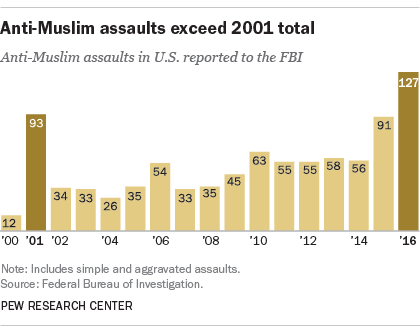
There's a lot to unpack there, but let's start with the numbers.


As Pew put it in an accompanying blog post, assaults were only about a quarter of the 400 hate crimes perpetrated on Muslims in 2001, almost all of which were in the last quarter. Harm to an innocent, whatever the motivation, is by definition a terrible wrong, so there are 400 real wrongs on display in this data; but for perspective on the awfulness of the plague of violence with which our political class was faced, in January of 2001 alone, in Los Angeles only, there were 230 felony assaults. In the People's Republic of New Jersey in 2002, there were 433 carjackings -- that is, more carjackings in a single state (granted, the Capital of Carjacking and Superfund Sites) than there were anti-Muslim hate crimes of every kind in the heat of the post-9/11 trauma.

It is by definition impossible to prove a counterfactual, but even taking arguendo the highly questionable and still-mysteriously-unproven assertion that words inspire borderline and not-so-borderline people to go kill a lot of people, it appears that at least 400 times, someone overcame our ruling class's word choice and committed mortal sins on the basis of the (at times perceived) religious belief of their victims; and yet, it was only 400 times, a number roughly equal to the number of homicides in Detroit in 2001. The operational theory was therefore that the ordinary, non-violent humans and the borderline-violent humans are too stupid to understand circumlocution, but the marginal number of violent thugs can see right through it, and if we're not careful, the majority will join the margin.

There is and was a great deal to be said for neither antagonizing predominantly or exclusively Muslim allies whose territory we would need for staging grounds and whose intelligence operations, however unsavory, would make our own more effective; but there is even more to be said for not treating the people who put you in office as itchy-fingered psychopaths eager to burn their doctors and neighbors alive because Mooooooslim.

As much as has changed since 2001, this has not.

This leads to the crux of the problem with "Easter worshipers." Our governing class is composed of people of fading religiosity, increasingly tenuous connections with their Christian countrymen, and all of the noblesse oblige and class awareness of a stereotypical-if-historically-ridiculous movie medieval monarch and none of the fear that sent kings crawling across their islands on pilgrimage to save themselves and their subjects from excommunication. I use the phrases governing class and ruling class tongue-in-cheek; they do not use those terms at all, except to try to live them.

The term "Easter worshiper" is detached, analytical, jarring, silly, clumsy, and more likely to incite than calm; but it's the sort of thing a group of would-be technocrats would say while analyzing the subjects on whose dial settings they're working. Hm, careful, mustn't let Group A know that the mice who died in Group S are Christian mice, they might riot or refuse to eat the infused pellets. 

Put very simply, our representatives -- our public servants -- are increasingly our rulers, in their perception if not always in fact. Representatives or servants will feel a connection to those who put them in power, and will understand that acting in the governed's interest is acting in their own. Rulers will do what they feel right for their subjects, knowing that they themselves need never feel those policies or the consequences. A representative fears for his own skin, on the day he rejoins the governed; a ruler fears the mob.

Standing alone, "Easter worshipers" is jarring, weird, and a one-off. As part of a larger data set, it suggests that the people who govern and imagine they govern us increasingly believe they rule us.

Thursday, November 08, 2018

That Time I Was Sort of Banned From Twitter But Not Really But Really I Was

Nothing I write will appear on twitter.com ever again. When I first started on Twitter in 2009, I used it as a place to gripe about experiences while driving very long distances. Overtime, I abandoned that for the most part, and instead focused on family, politics, humor, and culture. My blogging fell by the wayside, as did my long-form writing. I interacted with people that I sort of thought of as friends, and was able to interact with actual friends who had moved off of email and on to a medium notable for 140 character bursts.

Even a couple of weeks after the events, I am still somewhat ambivalent about being sort of kicked off. But first, let's talk about the events to which I just spent a paragraph alluding.

One of my great bugaboos is the extent to which politics, especially (but hardly exclusively) left-of-center politics takes people from being autonomous individuals and turns them into undifferentiated masses of political actors and at times mere objects for political warfare. To some extent, this is inevitable in any large governing entity, representative or not; and to some lesser extent, it is bound up in the very idea of mass popular suffrage. It is still a reversal of the profound intellectual and philosophical revolution Judaeo-Christianity initiated, which single-handedly raised the individual to a place of privacy above that of the gens or clan. That is not a good thing.

At any rate, Democrats, being Democrats, were doing that thing where they take a group of mentally ill people and use them as political objects. I objected.


(Twitter has black-holed the tweet, which makes what follows even more remarkably stupid.)

(Also yes, I play Empire and am finishing off Clash of Clans at Townhall 9; but the Cookie Jam logo is because Number Six decided she wanted to play it and I forgot to turn off notifications.)

I honestly didn't think much of this at the time. The idea's unremarkable: these are humans, created imago Dei, and they are, in the view of the medical community, in need of treatment and care. We owe them no less as fellow human beings and, quite frankly, as Christians, and they certainly deserve better than to be political footballs.

Not long after writing this, my account was locked. I filed an appeal, and explained that I was not speaking ill of these poor people, but rather demanding humane treatment for them. My appeal was denied without comment.

In order to begin posting again on twitter.com, I must do two things, after which, I will get a brief time out. First, I must delete the offending tweet. second, I must provide personal information to Twitter, so they can verify my account. Neither of these things will happen. I will address them in turn.


Twitter is a free (TNSTAAFL) service that uses my content and my eyeballs to sell advertising space and to slowly crash millions of dollars in venture capital. It is free to set its own rules, which apparently, though not in writing, include not reciting well-established medical opinion and basic Christianity.

Because that is precisely what I did. It is a well-established medical opinion that men who believe that they are in the wrong bodies are suffering from mental illness. It is a basic Christian teaching that those who are sick and wounded, mentally no less than physically, deserve care and treatment; and that because each human has inherent dignity arising from the act of Creation, he is not a mere political weapon.

It is also basic Orthodox Christianity that God created man and woman, and he made them male and female, he did not make two-spirits, genderqueer, I lose track of the buzzwords, but the short is, God does not smudge the line.

When I was young, I was taught to pray that I would die a martyr. I am not sure, even today, that I am brave enough to die as one, but I hope to be. I'm assuredly brave enough not to recant Catholicism on the threat of being unable to use a social media service.

Moreover, if reality means anything -- that is, if there are objective truths to be observed as common markers for communication and experience -- then we cannot smudge it away ourselves and expect everything to go well. I am Catholic not least because Catholicism treasures rationality, and I will not be irrational just to go along with the sick weirdos who move our culture.

In other words: Bruce Jenner is a man whom other men have tortured and sickened because they decided to celebrate his illness.

So if Twitter wants to delete that tweet, it's welcome to do so. It was posted on their server, and displayed using their software. I, however, will not.

This leads to the next problem.


I post under a pseudonym, and have for over 15 years, for a series of fairly simple reasons. I began by writing under my own name, and my family, which meant at the time my wife and then-only child, suffered financially for it. Once I began posting under the pseudonym, I began getting death threats. Some of those death threats extended to my wife and burgeoning group of children. Realistically, there is no real threat. So while the threat of financial ruin is gone -- I make my own bread, thank you -- I'm intensely jealous of my loved ones' lives, and I'm intensely paranoid, so I post under the pseudonym.

There are three reasons Twitter might demand my personal information as a condition of allowing me to use its service, in descending order of likelihood: To crack down on bots and automated accounts (something their investors and the almost-regulators who drag them to Capitol Hill would like); to mine for financial/advertising data; and to use against me personally. While the third option is not wildly likely, the people who believe saying "individuals suffering from dysmorphia are ill and need our care, not our enabling" is a hate crime are notoriously prone to believing those with whom they disagree are not differently-minded countrymen, but mortal enemies to be slain. They could narrow me down by IP address, but I'm not giving them a drop more than that.

Their service; their rules; I'm out.


As I said above, I'm sort of ambivalent about the whole thing. On the one hand, Twitter is addictive for the rapid-reward nature of how it hits your pleasure center. I legitimately enjoyed interacting and yes, at times, arguing with others in quick bursts. I truly enjoyed, and count as some of my best writing, the Thomas the Tank Engine and the Island of the Damned story I was almost 2/5 through. I enjoyed conversing with intelligent, pleasant-online-anyway people from all over. I loved telling stories about my kids, who when not trying to kill me, are making my life one great adventure.

On the other hand, most of the sub-variants of Twitter have sickened over time, like an infection of the feet working its way to various hearts. Conservative political Twitter is a war between large camps of people of varying levels of certitude of their own correctness (and varying levels of willingness to admit it) over how and whether to deal with the fact of President Trump. A lot of old stalwarts have gone mad and demanded that the GOP be punished for not assassinating candidate Trump, or at least, that's the logical implication of their smug satisfaction at watching Republicans who backed Trump survive and thrive while candidates who opposed him go down in flames. Parents-with-young-kids Twitter is fun but more and more nastiness and sickness seeps in over time. Catholic Twitter -- which has always been nuts in a way that even political Twitter isn't -- devolved not long ago into cosplaying the Great Schism, with each side imagining itself Humbert of Silva Candida.

Twitter was fun when it was a chance to share funny jokes, stories, some political rumination, science, puns, talks about culture of various kinds, and general camaraderie. It isn't fun when you've had to mute a third of the people you follow just because you don't want to burn a bridge you're pretty sure needs to be salted ash, and a third of the people who follow you because comment moderation sucks.

I've also rediscovered something I learned about this time last year after a significant hiatus: I get more work done and am better at long-form writing (joke about how I don't do any other kind goes here), though my ability to think on my feet suffers when I'm away from Twitter.

I've also relearned a lesson in humility, as my absence apparently hasn't even been noticed, let alone protested. I like to quote The graveyards are full of indispensable men to myself with some frequency, and this is a poignant reminder that I wouldn't even make those rows.

The great news, for anyone interested, is that I had more than toyed with packing it all up and shutting it all down with increasing frequency of late, but despite eleven requests for my Twitter archive, I never even got the confirmation email from that soon-to-be-Chapter-11 service. This means that while I cannot post, send direct messages, see my notifications, or even read the feed that comes from my followers, everything I wrote is still available for anyone who wants to read it, and clearly will be until the creditors' committee divvies up the assets to scrape $.03 on the dollar for the DIP financing guys.

In the meantime:


(The Von Trapps as reproducers were pikers compared to us, but much better singers.)

Wednesday, April 06, 2016

They All Fall Down: The Year Madness Finally Won


About five miles from my office lives a very nice young lady, who just cleared seventy years out of a womb and on this Earth. We'll call her Mrs. Martin, because she's a fairly unassuming woman who would be scandalized to know someone's writing about her on the internet. (When I asked her if I could, she said, "I don't think I'm important enough to be on the INTERNET.") Mrs. Martin is a sometimes-client of mine, a widow whose husband's love of America was matched only by his love of the United States Navy and Mrs. Martin's casseroles; she shared his love of America and of those casseroles, but she was sort of sour on the Navy by the time her late husband took his full pension. In her home there are pictures of ships with paint-pen signatures all over; of naval bases in sunset (her husband was a mildly talented amateur photographer and she had an eye for scenery); of children and grandchildren; of Ronald Reagan; of Christ; and of various, mildly kitschy Americana that one finds in homes of those of a certain age.

Mrs. Martin lives in a less-than-desirable-but-not-awful neighborhood, one like tens of thousands across the South, where you can walk from a broken shack to a collection of doublewides to some intact-but-not-much-more-base-style-housing to some old-but-well-maintained ranch styles, to some old-but-obviously-expensive-Georgian-eras, in no particular or consistent order, without once leaving the block. Hers is one of the penultimate ones, a lovely little house with a beautiful (if occasionally slightly overrun) front yard and some statuary that look like forlorn, worn angels, not least because that's what they are. The ethnic breakdown of her neighborhood is much like that in many such neighborhoods across the South, which is to say poor-to-middle-class-to-lower-upper-class whites, poor-to-middle-class blacks, and a passel of folks whose birthplace lies on the other side of the Rio Grande and whose kids were born there or here. The kids either split up by ethnic group to play or not play soccer, or mingle to play baseball or football, or, more recently, to play Jedi and Sith.

When I first met Mrs. Martin, I came to her house to discuss her legal troubles. She apologized about twenty minutes in and raced to her oven to pull out cookies, slid them onto a plate in that way older women have of reminding middle-aged-men that we're useless in kitchens, and raced out to hand them to the neighborhood kids getting off the bus. In a detail that struck me as unexceptional at the time but will be important in a few minutes, she smiled at each kid as he or she got off the bus (no parents around), greeted each by name, and handed each a cookie. She didn't skimp for any of them, white, black, brown, native-born or almost certainly not. She then hurried back in and we resumed.

When we next met, she undertook a similar pattern, but winter had finally called it a year and given way to spring, so this time, it was chilled lemon squares; the handout process was no different.

She called me not long ago to ask me some questions about the matters with which I'd helped her before, so I drove over to her house, honestly hoping to snag one of those cookies. When I pulled up to her house, I thought I must be in the wrong place, because I was greeted with signs that said, subtly, "TRUMP," and "MAKE AMERICA GREAT AGAIN," and honestly I stopped paying attention because there were a lot of them, I mean a lot, and I was having trouble processing this.

I'm Southern (well, Texan, but close enough), so as I sat in her living room to speak of minor legal matters, I engaged in the sort of gentle linguistic dance my people use when trying to communicate unspeakable horror to people we're suddenly unsure are capable of understanding it or their role in it. (My wife, a Yankee, finds this maddening even after a decade and a half of marriage.) This is roughly the verbal equivalent of saying, "Bless your heart," in different ways for about twenty minutes while the other participant refers to you as "a dear." This allows us to both exchange information and mild insults without resorting to gunplay; I would encourage it of urban-dwelling Yankees, but I think they lack the patience for it in the cold in which they live.

With her permission and as none of what followed was protected by the attorney-client privilege, I'll relay some of the more interesting parts.

Mrs. Martin loves her Facebook page. She loves keeping up with her children and grandchildren ("They're teaching me how to use the Skype soon!") and, she beamed to tell me, her upcoming great-grandchildren. She follows her favorite TV shows and a couple of authors and, of course, The Donald. She reads the Drudge Report, which might be too strong a way to say "she reads the headlines and then goes back to her chores and her Zoomba class."

When I asked her if she'd followed any of the, let us say, indelicacies of the Trump Adventure -- boasting of penile length, subtle suggestions that one cannot trust Hispanic judges, being endorsed by open white supremacists, the list is getting depressing -- her reaction ranged from sheer disbelief ("There's no way he said that!") to polite disbelief ("Why that's silly, he's from up North, they don't join the Klan up there" ) to indifference ("Politicians say silly things all the time, he's just doing what they do") to approval ("I'm glad someone is standing up for America again"). When I noted that, if some (but not all) of his ramblings could be taken seriously, they would mean that some of the nice children for whom she bakes cookies every day would be forcibly deported, she all but suggested I was insane -- no one could possibly mean that, he just meant no more people would come here illegally.

What came through, most of all, was that most of the things that would cause most normal Americans to light up Trump's life at a stake were news to her. Several surveys done in January and February showed that most of Trump's followers did not know the slew of damaging things he'd said and done; most could not have even imagined them. If you've followed the actual news -- not the internet, but news channels and news radio -- this shouldn't be a surprise. If you get most of your news from the internet, it's a different ballgame.

As someone who spends far too much of his life learning and arguing about politics and policy on the internet, it was one of those reminders that normal people don't. For a bit of perspective, as of this writing, Kim Kardashian-West has nearly 42 million followers on Twitter and 28 million likes on Facebook; Ted Cruz has 942 thousand Twitter followers, and a little over 2 million likes. (Donald J. Trump has just under 7 million followers and about 6.5 million likes.) In other words, a vapid woman who is famous for being the daughter of a famous lawyer, having a sex tape, having a healthy rear, and being famous, has a social media presence that laps many times both of the leading contenders for the Republican nomination for the Presidency. (For further perspective, a parody Twitter account that combines Mrs. West's vapidity and the musings of Søren Kierkegaard is almost half as popular as Senator Cruz's.)

Most Americans use the internet. However, most people use the internet to be informed about things they want to be informed about. We speak of self-sorting and -segregation on the internet -- like-minded people clustering together and reading things that reinforce their opinions -- but that's only part of it. The thing we tend to forget is that now that there are so many sources of information out there, you don't need to watch the evening news for that one segment on the movie or celebrity you care about, or as a lead-in to Entertainment Tonight. Today, you can get what you want and never dip your toes in anywhere else.

What this means for the future of the Republic ... well, let's stick to one depressing topic at a time.

Mrs. Martin is not a one-off. Anecdote is not the singular of data, as a friend of mine likes to say; but in political years, I like to actually speak to people other than exceptionally smart people who write on the internet and see what they're thinking. I've had occasion to travel throughout the Bible Belt over the last few months -- they should possibly rename it the Trump Belt for how well the oleaginous, Godless, orange-hued carny has thumped the unctuous little Hobbit Cruz -- and a fairly consistent pattern has emerged: If you are white (or surprisingly often, black), not a professional, usually but not always vote Republican, vaguely Protestant, and are on the wrong side of the income curve, you're going to speak up for Trump. You're going to talk about America as one does a lost high school love; maybe you're going to make somewhat embarrassed references to the Mexicans Who Hang Out In the Home Depot Parking Lot taking jobs; maybe you'll talk about hating Congress; maybe you'll talk about how hard it is to make ends meet; maybe you're mad at the Democrats for trying to destroy Social Security (forget it, he's rolling); maybe you're mad at Obama (who may be a foreigner or worse, a Yankee) and you want someone who will stand up for you against him; maybe any number of things. Sometimes you'll say you'd vote for Bernie Sanders if you thought he had a chance. Sometimes you'll say you thought George W. Bush was a good man and a good president but he didn't stop the jobs from going away or people from falling behind. There is a giant, roiling mass of undereducated, underinformed, angry, depressed, mistrustful Americans out there, and they have decided to care, and to do it in the way undereducated, underinformed, angry, depressed, mistrustful people often do.

This makes a lot of people angry. Were we still a Republic in all but name, that anger would be righteous and indeed it would be right. But of course, we're not.

In American politics, where we fight over the tiny morsels over which we are still allowed control of our lives, it's often an easy shortcut to treat our opponents as slavering, fanged enemies. It makes our own insanities easier to ignore; and when they burst out, harder to contain or even recognize.

And that is why the Republican Party is trying to commit suicide, albeit in its usual, clumsy, inelegant, and ineffective way.

In 2015, the Republican Party went very slightly mad. Like all great madnesses, however, it was not so much a single mental illness, but a collection of clashing delusions that manifested as so much self-righteous chaos and, ultimately, mental and moral bloodshed.

It was a year that saw (the loudest) Republican voters and activists reject The Establishment, a hazy and nebulous group that might best be described as the Senators and Congressmen they'd duly elected and re-elected for years; the lobbyists and various remoras attached to their underbellies, and whose class those same Congresscritters aspire to join; and wealthy, odd people, mostly distinguishable from the wealthy, odd people who underwrite Democrats because of their fascination with carried interest and their higher rate of being self-made before going odd. The epicenter of this hatred -- Where the Establishment Lives -- is the imperial capital of Washington, D.C., and the portions of Maryland and Virginia it has annexed spiritually if not legally. The Treasury Capital of New York would get the occasional hate-mention, too.

It was therefore a year that gave way to another year in which a native New Yorker who has taken his slumlord father's sizable fortune and turned it into a slightly more sizable fortune (exact figures are a royal secret) through the generous application of lucre to the imperial class; two sitting Senators; and a governor who spent the most significant part of his prior life as a Congresscritter and as a servant of one of the Mandarins of the Treasury Capital would edge out sitting and former governors who by and large had never been part of the imperial class and who promised to overthrow it. Those same governors, with the exception of that one lucky non-entity, found their political careers and reputations at least temporarily destroyed, especially if they had the utter lack of grace required to note that the orange carny from New York is historically left-wing on almost everything; a longtime funder of Democrats and prominent, moderate Democrats; and more importantly, clearly out of his barking mind.

That story, itself, would be a madness worth savoring were it happening to the Democrats, but this is only the surface madness to which the Republican Party had fallen prey. Just below that surface were deeper madnesses, at war with each other as surely as they were with reality, like lobotomized sharks whose left fins had been amputated. Consider those who march under the banner of madness.

Let us begin, as we sadly must, with Donald Trump and his band of monomaniacs -- and those who follow in their wake.

The first thing one must understand about the entire Trump movement is that it is not so much irrational as anti-rational; it is a profession of faith that some facts are more equal than others (one supposes it's nice that we finally got low-church Protestants to make a creed of some kind). It is a belief that cuts across the entire movement, from the batty crypto- and not-so-crypto-Nazis who infest the Twitter mentions of anyone who suggests that whites are not, in fact, undergoing a genocide (we're not); to the very nice and very motley crew who show up at Trump rallies to raise their hands like sexagenarian school children when asked to declare their loyalty to Brand Trump; to the Mrs. Martins of the world; to Chris Christie, bless his fat heart. It's a belief that the polls that have been more or less accurate in identifying Donald Trump as the leading vote-getter in most Republican primaries so far, on which Trump has staked his electoral credibility, are conversely lies and plain error when suggesting that he's dead come the general election.

This is not to say that these people, individually, are irrational. (The White Genocide People, however, are.) It's to say that there are several, unrelated intellectual threads that have converged to bring about this state of affairs, and they appear to have reached a perverse apotheosis in Trumpland.

There is, first, the belief that the elites are stupid. There's a great deal of merit to this, and a great deal of evidence to support it; after all, those same elites judged Trump a non-factor a year ago and less. Those elites -- politicians, consultants, pollsters, political science professors, opinion writers, that one guy who drove the cab that picked you up when you flew into LaGuardia and who's gonna be back on his feet in no time -- managed to misread the electorate's composition, mood, and intellectual capacity in almost every relevant particular for years. Thus, if the elites are saying something that cannot be or has not been demonstrably tested, you may safely assume that they are wrong; and the fact that they were wrong about Trump before the primaries started suggests they're wrong about him before the general election.

There are obvious logical and rational problems with this. They're not important because you cannot reason with people when their emotions are high, as Twitter is in the habit of proving. What makes the problem worse is the death of expertise, or more accurately, All Americans Are Trial Lawyers Now.

Trial lawyers, of which I'm one for my sins, are guilty of a particular fallacy in which after enough time litigating a matter, we come to conclude that we are experts in that matter. (Spoilers: We aren't.) This unfortunate combination of rank ignorance and even smellier hubris has somehow trickled into American society at large, aided by an internet full of sites and people who don't know very much (or who do but don't want to give away their livelihoods). Americans think they look up something on Wikipedia or through a Google search, understand about seven of every ten words (or maybe all ten), and so without any background knowledge or practical experience, can go toe-to-toe with the best. It's a bad proclivity made worse by a lot of the ridiculous marketing technology companies and idiotic politicians do.

Thus, if you're the average American with any kind of internet connection, and you see the Experts being Wrong about something about which you were Right, you conclude that the Experts are Idiots and You Know Better. Thus, Experts who think Trump is gonna get pasted by Hillary Clinton don't know the way you do that Nuh-Uh.

Again, this is a conclusion that is prone to fallacies that begin with Blind Chicken Finds Corn: Story at 10 and continue from there. It is a complete and completely ridiculous logical error, and worse, it is dumb. Unfortunately, all of those warnings in the Federalist Papers about the dangers of ignorant mobs went right out the window some centuries ago, and now we don't even check to see if you can fog a mirror before handing you a ballot card. Worse, when we eliminated the structural barriers to hordes of people in the grip of being stupid voting, we also raised the prerequisite madness to the level of national virtue -- we applaud the fact that anyone, no matter how insane, stupid, rootless, and undereducated, can form a mob to vote. In fact, it is now considered un-American to argue that people who cannot find Washington, D.C., or their own state capitals on maps should be unable to vote; and worse than that, it's elitist.

So when actual experts and informed humans point to data that says Trump is gonna get trumped, or -- more on this to follow -- no matter how many trade barriers and wages we raise, we cannot return to a world in which manufacturing employs a huge share of Americans, the people most affected by this news tend to tune it out because they know better, and they've been told that being a noble savage is better than being a pointy-head who didn't even understand how Mr. Trump was gonna win it all.

Yet this is only the first problem of many.

The next intellectual root of Trump's ascendance is that the world as we've historically known it has more or less fallen apart, and those same elites are viewed as at best clueless or indifferent, and at worst actively malignant to the men and women over whom they govern, nominally with those same men's and women's consent. This is made worse because in some unfortunate ways, Republicans are all libertarians now.

Libertarians who infest think tanks are mild idiots of a very specific kind, and their peculiar way of seeing the world has filtered into too much of the Republican and conservative little-e establishment. An example will suffice. Many of Trump's voters will say, American manufacturing is dying. Taken on its face, this is actually not merely incorrect, but wildly so: American manufacturing is in great shape; we export to the world and the world cannot get enough of what we export. Our manufacturing GDP fraction is doing just fine and has been for years.

And that is precisely what libertarians and therefore most Republicans and conservatives will reply. And it is not merely right, it is also amazingly, fantastically, stupid and tone-deaf.

When Trump voters and others say, American manufacturing is dying, they do not mean, American GDP as a measured by the fraction of the same arising from manufacturing industrial and consumer goods is decreasing, and not merely because only people as weird as I speak like that. They mean The manufacturing jobs that gave high-school graduates and pre-graduates a middle-income lifestyle are gone and not coming back; and the sense that America makes, the world takes, and America is the arsenal of democracy, and America is the world's industrial powerhouse, are gone with it. They logically assume that we're not making much stuff and selling it any more, but they're much less concerned with the chicken than its implications about the egg.

It only took an entire recession and limp recovery for the Cato sorts to start to respond, and their response, today, is: Wow, that sucks. Have you considered training for a different job in the exciting nursing sector? Or Well, sure we import from China and places where labor is even cheaper, but now things are cheaper at Wal-Mart! You should be grateful!

And as with almost anything and everything that breed of libertarians says on economic subjects, this has the double edge of being both absolutely right and insanely stupid. High (union and non-union) wages made and make American labor noncompetitive. High-tech advances make things other than certain niche industries (finished furniture, specialized surgical equipment, etc.) more capital-intensive than labor-intensive. The cost of living as a share of income has plummeted, in everything from food to household goods to consumer electronics.

And to the point: Manufacturing jobs are dying and they're not coming back, and the people who used to or would work in that sector really do need to find different ways to make scratch. (I'd counsel something besides medicine, but we decided about seven years ago that we were going to eat all of our seed corn to make sure no Medicaid wasn't expanded.) This is the inevitable result of technological progress and free markets: We do not mourn the untold souls who lost their jobs in uprooting tree stumps when the coal revolution hit England, nor the horse-cart manufacturers whose livelihoods ended as the iron horse and then the horseless iron replaced their livelihoods.

But we do not mourn them not merely because they are removed from us by decades, but also because the very nature of work and life have changed in a way that it did not a century and more ago, because the men working those jobs could move to one more kind of barely-skilled or unskilled labor; today, that work is rapidly vanishing, but the percentage of humans who can only do that work is not.

The jobs we used to offer for those who could barely make it through high school, if that, are disappearing all over, in every sector. Humans draw a sense of dignity from work; if there's no work, they will feel they have less dignity. This is a very real and pressing problem for the increasingly large share of American humans who are unemployable at any wage that meets even basic sustenance levels. It is a worse problem when you remember how many of these are men, and gender-theory-nonsense to the side, genetically normal men of every race, creed, and color are hardwired to provide for their families, cause violence, and/or both. It is even worse when you realize that across every possible population division, there are and will be men with strong backs and rough hands and those are the talents they will bring to a job market that couldn't care less -- and that even men and women who can bring more to that market increasingly find that they lack any marketable skill of any kind.

And so the American policymaker response, when they've noticed, has ranged from idiotic ideas like trade barriers (destroying the manufacturing jobs we have and driving up prices on basic goods), to a higher minimum wage (further rendering American workers less competitive), to sending make-work projects into Congressional districts and West Virginia, to job retraining for thirty-to-sixty-year-olds (presumably on the theory that old dogs can indeed learn new tricks), to taking the whole passel of Federal benefits and lumping them into a giant payout so that folks can go on the dole and sit around while not cluttering the system with fraud and waste.

There are no easy solutions because we are in the midst of several revolutions at once: of technology, of trade, of demographics, and of politics. But as bad as bad answers are, as intractable and convoluted as the problems are, it's the fundamental incompetence, tone-deafness, and dishonesty of those policymakers that is driving the Age of Trump (and to some extent, the Age of Sanders). Our political class largely gave up its political power to the Executive Branch subset, and instead exists purely to dole out money and retire on sweet, sweet investments curiously timed with major legislation, and jobs lobbying for more of it. And yet, even at that, they are incompetent: Their efforts at legalized money-laundering have been at best ineffective and worse counterproductive in dealing with a growing, dangerous, social problem. And Americans have noticed.

Yet this is hardly the alpha and omega of either negligent or callously indifferent misgovernance, and the rho and theta are part of why Donald Trump will be the leading vote-getter: immigration and Islam.

The portion of even Republican primary voters who think all illegal aliens (sorry, undocumented-Americans) should be deported constitutes a loud but undeniably not very large or electorally significant number of people. In fact, poll after poll, including exits from this year's primaries and caucuses, show that most Republicans support pathways to legalization and/or citizenship for those same non-papered aliens; and yet the two candidates promising the ugliest solutions to our apparently-immortal immigration fiasco are the two candidates left standing. This by and large mirrors a truth about the American people: Most of them don't have the words "GANG OF EIGHT" burned into their synapses and tend to have bought into the sepia-toned picture of immigration as How America Was Built And Made Better (the riots, anarchists, Presidential assassinations and attempted assassinations, social unrest, socialism, and ethnic tribalism somehow don't make it into the film reel), but somehow they keep re-electing people who go to war to stop any attempt to turn our helot class into citizens. This is a bit of a puzzler, but the consistent elite response is to keep doing the same thing again and again: offer a bill that directly or indirectly offers amnesty to illegals and directly or indirectly offers citizenship to illegals, claim it's not only the best policy choice but a moral and American duty, lose, call their opponents racists, and fight against or tacitly encourage the abandonment of enforcement of our immigration laws to achieve the same end. With roughly the same breath, they will then deny that there are any problems with mass immigration, helotization of our fellow men and women, and porous borders. And, to top matters off, they now say that instead of using terms used for the centuries since our Founding, we should refer to these men and women not as "illegal aliens" or "illegal immigrants," but as "undocumented"-various-things.

Hold that last in mind for a second; it'll be important in a moment.

Since the early 1990s, Muslims have been blowing up, shooting, attacking, crashing planes into, knifing, and otherwise mass-killing non-Muslim (and in a smaller percentage, Muslim) American civilians with a fair level of frequency, broken largely by the Presidency of George W. Bush. This is not really all that remarkable; Muslims were doing a lot of these things to Americans right after the United Kingdom called enoughsies in 1781, a behavior that continued through every century since. What changed, however, is how the American elites described and reacted to these events.

If someone runs up to you and yells, "I will kill you for Christ commands it," and holds up a knife with a cross on the pommel (therefore making two crosses if one includes the hilt and crossguard), and makes some noises about protecting the See of St. Peter, and maybe brings up transubstantiation on a downswing, you'll not only be amazed by his energy level, but you might come to the creeping suspicion that this man is Catholic. If one further discovers that he attends daily Mass, wears a hairshirt, has forty or so kids with his wife, and has ashes on his forehead on this very odd Ash Wednesday, that suspicion is gonna waggle its eyebrows and suggest it's actually a conclusion.

This sort of rational sorting -- taking the human proclivity for categories and matching it with data -- is what ordinary humans do. It is not what our political class -- Republican and Democrat -- does when confronted with men (and women) yelling, "Allahu Ackbar!" while performing any of that list of horribles, not even when discovering that the nice young fellow was a regular at the mosque, undertook the Hajj multiple times, posted on HududIsAwesome.net, changed his name to Mohammed bin Mohammed, skipped reading everything except jihadi sites and his three worn-down Qurans, grew a beard, and promised to restore a Caliphate. So ridiculous has this become that whenever the Islamic State on orders from its Caliph engages in its weekly atrocity bonding activities, blows up Belgium, etc., our political class rush out to explain that these folks aren't Muslim, they have nothing to do with Islam, and also we're going to import a lot of these people now, racist. We'll call them Daesh, because they hate that, and they're not really Muslim, which is what the nice fellow from CAIR told us to say or else we'll be racists.

The imported people are, of course, settled in the hinterland and at any rate far from the Imperial Capital because, well, no need to go crazy here. Meanwhile, that same political class will remind anyone who will listen about the recent atrocities committed by Christians, for example the Crusades, the Crusades, the Salem witch trials, the Crusades, the Thirty Years' War (if they're erudite enough), the Crusades, the Inquisition (of whatever kind), also the Crusades, and possibly the Holocaust (because if there's anything Hitler and the Nazis were, it's devout Catholics and Lutherans). And oh yes, the Crusades, which must exist outside of their historic context, nature, actual history, and even reality, because they're the Crusades.

This particular failure has more fathers than usual, as it's bipartisan: There's the left-wing identification with the poor and marginalized, grafted onto just under a billion people because of the (to their mind related) sin of colonialism, which becomes racism through a grotesque transubstantiation, which is at any given time at least tied for The Worst Sin of All. There's the right-wing Fear of Being Called Racist. There's the intensely condescending fear that every Muslim is a barely-contained suicide bomber just waiting to be hatethought into killing innocents. There's the intensely condescending fear that ordinary Americans are going to mass-murder in horrifying ways doctors, hotel owners, and gas station operators if you admit that the couple who just shot up a community center are, yes, it's true, Muslim. There's the worry about losing Michigan's electoral votes (and I guess Minneapolis's?). There's the concern that we won't get more exchange students from the Arabian peninsula to whom we can teach nuclear engineering for their return trip to Yemen. There's the abiding fear that the British, French(!), and Germans(!) will call us bad people. There's the pragmatic fear that it will be harder to extract favorable terms for our foreign policy in the Middle East and South- and Southeast Asia, as well as favorable terms for getting liquid black stuff to make our economy go. There's intraclass signalling -- we don't give into racism, we are better than that. There's just flat-out stupid and/or functionally illiterate, which should never be underestimated.

But what Islam and immigration have in common is not so much race (though they can both be proxies for race) or xenophobia (though again, this does influence at least some fraction of those concerned by these things), but rather a well-deserved reputation for being untouchable subjects by our political elites. The language we are allowed to use to describe these problems -- and the language we are not allowed to use -- is a both a symptom and a signal of the larger issues.

Let us take the word alien. Alien derives from the Latin alius, other; skipping the usual French transmission of Latin to English, it originally had nothing to do with extraterrestrials and simply meant strangers to one's land. Thus, early American laws on foreigners -- even ones who would become American -- referred to them as aliens. Over time, this usage persisted so that until very recently, we referred to legal aliens (strangers here legally) and illegal aliens (strangers here not-legally). To call someone or something alien is not to engage in racism or any actual sin; it is simply to describe a thing using slightly arcane language.

Starting a few decades ago, it became more fashionable to refer to these strangers as immigrants, a word that is technically both accurate and inaccurate. An immigrant (Latin: migrare, to depart, which then became migrans, one who departs, combined with im which prefix means into as opposed to e, from) is one who departs his place to come into ours. The connotation of immigrant however, is somewhat more permanent than alien, which refers to one who is a stranger for any length of stay. Nevertheless, Americans are not all Latin buffs, so we ran with it.

In the last decade, someone decided that immigrant sounds racist and othering (a portmanteau that a just God will punish with the Fires of Hell), and that illegal immigrant is somehow worse; and all of a sudden, American politicians of both parties explicitly or implicitly declared that calling strangers who come into our land outside of our laws either of those words was racist thoughtcrime.

Similarly, over the last decade and a half, American political leaders have been at great pains to pretend that Muslims who kill people in the name of Islam and subscribe to a system of Islamic belief that has roots at least in the 18th if not 8th century, and whose actions are supported by between ten and fifty percent of Muslims worldwide, are not, in fact, Muslim; and to call them Muslim is that great of American sins, racism. (Islam, like Christianity, perceives itself as a universal faith, which means one open to all races, but it is thoughtcrime to note that, as well.)

Americans may not be amateur etymologists, but they are not actually fools; they understand that this is not an attempt to be polite -- something that even Yankees unconsciously do -- but rather an attempt to control conversation, thought, and action. It is nothing new to remark on how the left likes to control thought through the control of language; a clever fellow named Orwell remarked on it in a nearly eponymous essay decades ago. It is something new to see the nominal right engaged in it as well. It suggests that at some point, solving problems became less important than not making people upset that you recognized them.

But not only does this convey a profound sense of unseriousness -- anyone of even minimal intelligence knows that it's hard to fight a thing if you won't call it by its right name -- it is also a subtle but profound announcement that We are not like (by which we mean, "are better") than you rabble. It says, We do not worry about the same things that you do, and to worry about those things, to call them by their right names and express concern, is racist and honestly isn't nearly as important as making sure politically-connected individuals and corporations get rich. It also says, Trust your betters, morons.

It is dangerous in a Republic for the elected class and voting class to be perceived as too far apart; the 19th-century devolution of the Democratic Party into a bread-and-circuses-band-of-socialists and 20th-century-near-mimicry by the Republicans owe in no small part to a perception that the ruling class had grown too far from those who elected it. It is infinitely more dangerous in a mass democracy, where the rule of law, tradition, and unwritten rules of civil society are far less important than the will of the masses.

We are seeing the danger play out as we speak, and we should count our blessings that it so far manifests only in two senile old men from New York launching insurgent campaigns against their political parties for the role of King for Eight Years.

To diagnose a problem is not to excuse it. It is un-Christian to encourage another in sin, in delusion, and in error. Many of our countrymen are gripped with delusions about the power of government to achieve various utopias, to end the flow of human migration in a way never achieved by any group of humans without resort to truly horrific means, to arrest technological progress, to alter the prevailing zeitgeist in the country, to control the economy and produce boundless wealth and probably some really cool little American flags.

They also think that a dude over half the country actually viscerally hates, and for good reason, will get elected President, and then maybe turn water to wine.

Minds are like parachutes: They keep you from getting killed by being open at the right times, and being closed at all others. Knowing when to open your mind is like knowing when to open your chute: Too early and you're going to get sucked into a jet turbine, the plane crashes, everyone dies; too late, and you're gonna go splat. Trump's supporters are tugging the ripcord and the door isn't even open yet.

The future may be the undiscovered country, but it will only be Heaven when Christ returns in His Glory, and the past is now Atlantis. Trump will get annihilated in a general election, assuming he even wins the Republican nomination, something he stubbornly refuses to do. The Jews don't control the world (if they do, someone needs to tell them they're doing it wrong before even more of them get massacred). Immigrants tend to crowd out other immigrants, and not very much native-born Americans, for jobs. Having illegal immigrants as our helot class is morally reprehensible, but keeps the price of all sorts of things down for citizens and immigrants alike. Mexicans are humans, as is notable from the remarkable number of Americans throughout the Southwest and elsewhere descended from them. The destruction of our manufacturing labor base has made the cost of goods on which we rely many times cheaper for everyone, and is a double-edged sword cleaving through China (which is losing factory jobs to cheaper locales as we speak) as much as here. Mexico won't build a wall. The Mexican border has been porous, as has the Canadian, since there was a United States and then a Mexico and a Canada to share borders. Americans don't have enough babies, so we have to keep importing adults in place of the adults we decided not to make or just to abort, and everywhere else is running low on those, too. Technological progress is not merely continuing, it is accelerating, and the effects are and will be revolutionary for years, and revolutions are almost never bloodless. We keep electing the same group of morons, and the collective action problem and our own rational apathy empower them to screw us over; no one else foists these sub-cretins on us.

Whatever my, your, our problems with Ted Cruz, Marco Rubio, indeed any of the major Republican candidates with the exception of John Kasich, they are not boorish prigs whose entire public lives are repudiations of decency, good manners, and some sort of respect for what's left of our civil society. Donald Trump may or may not be evil, but he is assuredly all of those things and worse. To support him is not to harken back to an America that was, it is to spit on an America that once held those things as so important and essential as not to need mentioning.

He is a man who has boasted of his atheism because of course he's an atheist, he's intelligent; who has defended the murder of the unborn for basically the same reason; who has endorsed most left-wing, freedom- and liberty-crushing idiocy at one time or another; and moreover, who gives every indication of slowly giving into senility. He has at least accepted if not tacitly encouraged open and brutal racism -- real racism, not "enforcing immigration laws." This brave defender of free speech and free thought wants to make it illegal to criticize him, and backtracks on each and every promise his supporters hold dear as the whim hits him. He is not so much a rock in a storm as a stray newspaper in that same storm, and not just because he's all wet.

These are all truths and unfortunately obvious ones. The willing and deliberate refusal to accept them; to refuse to admit they exist; and indeed, to sometimes eschew sufficient civil responsibility to even be aware they exist is a complete dereliction of some of our basic duties as citizens and as human beings. I have a soft spot for the Mrs. Martins of the world in no small part for the contempt I had for them as a child, but while they are not entirely to blame for the world in which they live, they are also not without responsibility for it. To pretend otherwise is to treat them as children or unwitting serfs cast against impossible forces; I leave that to my Church, which is remarkably good at that, and the rest of us should hold them to the standards of adulthood.

In doing so, however, we must not lose sight of why these people are where they are; what they care about; and most importantly, that they are our fellow Americans, and deserve at least some charity on that account. For example, compare these two pictures:
The picture on the left is of Ted Cruz with a bunch of people raising their hands at him. The picture on the right is of Donald Trump with a bunch of people raising their hands at him. The picture on the left is taken to be that of men and women doing the somewhat silly thing a lot of Protestants and an unfortunate number of Catholics do and raising their hands in blessing as if they're priests. The picture on the right immediately generated cracks and actual, serious, not-kidding-at-all commentary about Nazis.

For just a moment, consider that. There is actually more or less no way that a bunch of Americans of that age and demographic spread, without neo-Nazi uniforms, are going to do that (sloppy; the hands are crooked and raised not straight-and-out like the Hitlergruß, which is something you can see if you look at anyone but the guy front-and-center). It is a perverse Manichaeism, explicable but not excusable by election-year fervor, that would drive us to call our fellow American Nazis when they give no indicium of being so other than supporting a political candidate who rightly arouses distaste in a supermajority of Americans. It is an inexcusable failing of charity; it is also profoundly stupid during an election year in which the numbers favor the Democrats.

What those men and women were doing is something almost as bad as a Nazi salute; they were raising their hands to be counted, like children eager for the teacher's attention. They were showing their commitment to the cause of Donald J. Trump, and promising to support him. They were acting not like free men and women, but like bound vassals pledging their loyalty to a strong man. This is a profoundly un-American impulse; it is self-demeaning; and out of charity and decency, it is incumbent upon us to say so unequivocally.

Instead, we mock, and we analyze as if dealing with laboratory specimens, and we hope they'll go away. That's worked swimmingly so far.

But our failure to empathize with and understand the men and women disrupting what should have been a wildly successful Republican presidential contest is only the beginning. We must also understand why they have sent packing much, much better candidates from the Republican field.

And also why they are still beating Cruz, Rubio, Kasich, and their faithful.

A certain amount of shared myth-telling is natural for a political campaign, especially one in which we elect a king who is more or less glued to his seat for eight years, and who appoints a permanent group of kings to carry out something like his will for decades. Good political campaigns harvest the raw stupid that people naturally invest in men and women who would step over their own mothers for power and leverage that into a coherent political movement: Barack Obama will bring about racial healing, George W. Bush will return dignity to the White House, Bill Clinton will bring about Tomorrow and ... honestly, I still can't figure out what his campaign was premised on, other than being a Baby Boomer and having troubles keeping his pants buttoned.

In other words, it's entirely normal for otherwise intelligent people to invest themselves in the putative god-kings for whom they vote -- not desirable, not admirable, but normal. It is also normal, though less excusable, for those who would lead them to further those same delusions.

Various entertainment personalities have come in for flack for all but worshiping Donald Trump's withered rear end. I largely agree with these critiques, but it's important to remember a critical detail: These are for the most part not serious thinkers, with the arguable exception of Rush Limbaugh, who has made a career out of saying, "Aw, shucks," a lot while showing a remarkable depth of policy and history knowledge.

But -- and it is very important to separate causation, enhancement, and culpability here -- the roots of the Trump movement are in some ways deeper than radio and television personalities desperate for ratings or at least not inclined to upset an friend.

The modern conservative movement was in many ways founded by William F. Buckley, Jr., who famously remarked that he would sooner live in a society governed by the first two thousand names in the Boston telephone directory than in a society governed by the two thousand faculty members of Harvard University. His brand of conservatism was always a delicate balance of refined snobbery combined with a populist anti-elitism that was born in no small part of the fact that the elite of his time were overwhelmingly sympathetic to the Communists and otherwise fairly dim. This rejection of the elites and elite education has continued for decades, and spread throughout not just the conservative movement but through the populist and other movements it has spawned.  Conservative media makes bank on this idea.

Those ideas, in turn, have trickled into the greater culture. The average American doesn't know a thing about Buckley; but he knows that Harvard is full of leftwing, detached snobs who can't be trusted to run a soda stand at a high school football game. He knows that those same elites are dumb and wrong and are basically untrustworthy. (He's often right, but often wrong, too.)

This by itself would not be nearly so bad, except that it meets perhaps the most important and most obscene of left-wing myths, that of the noble savage, and the American assimilation of that character: the plain-spoken, un-fancy, has-no-need-of-book-learning-hero who is more virtuous for not being civilized. So embedded in our culture is this trope that you have to immerse yourself in another culture to see it. It's the lawman who doesn't need the bookworm droning on, the criminal who does right or gets ahead while the smart people destroy the world, the tough guy hero who outsmarts the guy with the 235 IQ, all of it while scientists and bookworms sit by helping and hoping for just a bit of his reflected glory.

In real life, that guy ends up grabbing the back of a garbage truck, or maybe lucks out and does used car or real estate sales, or maybe ends up a line adjuster for an insurance company. These days, he's on disability, bitter that the factory and equivalent jobs are gone, and possibly trying out painkillers. And he's being told, repeatedly, that it's the elites' fault that he's in this mess.

It is unjust to hold people responsible for unforeseeable consequences of their actions; and writers left and right are not responsible for the rise of Trump because the idea of a TV personality tapping these things as a sales pitch to come within striking distance of imperial power was not reasonably foreseeable.

But the men and women who now back Trump undeniably live in a world we (and I include myself here, pitiable and irrelevant though my contributions are) have created. They swim in our ideas, however indirectly transmitted. Of course they reject the guys who've been in government of various kinds for years; who tell them that free trade is good; who tell them that miracles don't happen in policy; who tell them that any fight worth winning is a long slog. They reject those things because it is very hard to separate yourself from the world in which they've lived their whole lives, and they have no time for the responsible men and women who sound as patronizing and ineffective as those useless elites way too often.

I would like to add a bit more color to Mrs. Martin here, a figure of speech that in some ways should be taken literally. Mrs. Martin's real name, of course, is not Martin; that was her mother's maiden name. Mrs. Martin descends from Scots-Irish stock littered through Appalachia and a traveling salesman from Pennsylvania. Her married name ends in a vowel, because her late husband was a Filipino national who loved America so much his heart was near to bursting at the thought of joining its armed forces; who enlisted and served first on a cruddy little destroyer playing cat-and-mouse with the Soviets; who met a winsome American gal at a base at which he was stationed in the late Sixties and who seemed to embody all of America's bravery and boldness and beauty and so kept asking her out and kept getting turned down until she said yes once and then yes one more time and then said I do; who duly fulfilled a dream he'd developed watching the American reconquista of his native islands and became an American citizen; who fathered five children; and who insisted on being buried with an American flag and his worn-down rosary. His widow, a lapsed Presbyterian, eventually became a de facto but not de jure Catholic (like many if not most Trump voters, she's been to church, she's just not very churched -- she goes to Mass about three times a year), and her children are to a one married, sporting impressive broods of their own, and rather clearly the sorts of people a lot of Trump's faithful on the internet hate as half-breeds. (Most of them are "horrified" that their mother is supporting Trump.)

After indirectly trying to puzzle out why this otherwise decent human being is supporting ambulatory sewage runoff for the Presidency, I more or less directly asked her why she would vote for a man like Trump. (This took roughly three minutes.) This is a college-educated woman who, like her husband, loved America as a land of freedom and hope and integrity; who has five children and many grandchildren who for obvious reasons are squarely in the crosshairs of at least some of Trump's more enthusiastic submorons; and over whose mantle fly an American flag and a Gadsden flag, side-by-side.

She dropped the nice Southern lady routine, looked me in the eyes, and told me that she had watched the world fall apart in the Sixties, and had seen the world spit on America in the Seventies, and would not see that happen again, I noted that Ronald Reagan had stopped that the first time, and Donald J. Trump is no Ronald Reagan.

She took a sip of her sweet tea and said, "Someone needs to be."